RUN-CHICKEN T50 Automatic Coop Door
RUN-CHICKEN · doors
$130–$190
Direct merchant link. No affiliate tracking is currently configured.
Research-based guide. Outdoor Tech Index has not hands-on tested this product.
Quick overview
Chicken keepers who want a compact complete automatic door with no wiring or subscription and who can keep the vertical rails clear and inspect the flock daily
Potential advantages
- A complete door rather than a motor-only opener
- No mains wiring, solar panel, hub, or paid service is required
- Compact all-in-one design reduces the number of exposed moving parts
- Manufacturer publishes cleaning, alignment, battery, and light-sensor troubleshooting guidance
Potential limitations
- The opening can be tight for unusually large birds, so measure before ordering
- Ice, debris, an out-of-level wall, overtightened screws, or artificial light can interfere with operation
- Current app-enabled versions and older button-programmed retail inventory can be described differently
- Outdoor Tech Index has not independently tested predator resistance, battery life, or cold-weather reliability
What we think
The T50 is a practical fit when the main goal is automating one reliable pop door without building a separate motor, panel, power supply, and controller. The current manufacturer page lists a 13.8 by 9.4 inch aluminum assembly, two-AA power, light-based operation, app programming, and an obstruction response. Those are meaningful conveniences, but they do not turn the door into an unattended security system. The rails still need to stay vertical and clear, the light sensor needs a truthful view of outdoor light, the batteries need planned replacement, and someone must confirm every bird is inside before the close cycle becomes part of the nightly routine.
Verdict: simple hardware, but the installation is the system
The RUN-CHICKEN T50 makes the most sense for a conventional backyard coop with a flat vertical wall, a flock that comfortably fits through the opening, and an owner who values battery simplicity over remote monitoring. It is a complete aluminum door, not merely an opener for a panel you must build. That makes the purchase easier to understand than a motor-only kit and removes cable routing, mains power, and a separate door from the first installation.
Skip it if the coop wall is badly warped, the opening must serve very large poultry, ice regularly forms across the threshold, or you need verified remote status. The app programs supported versions, but this is not a camera and it should not be treated as proof that every bird is safely inside. The best use is routine automation backed by a physical evening check, a manual recovery plan, and a second layer of predator protection around the run and coop.
Price and total cost of ownership
On August 19, 2026, current direct and retail listings put new T50 variants roughly in the $130 to $190 range. RUN-CHICKEN listed a current T50 color variant at $139.90, while retailer prices and color or connectivity variants can differ. The manufacturer also offered an optional one-year extended warranty on at least one direct listing for $19.90. Treat both figures as a same-day snapshot and check the exact model in the cart.
There is no subscription, cloud fee, required hub, or required solar accessory. Two AA alkaline batteries are included. The ongoing cost is replacement batteries plus ordinary cleaning supplies. The manufacturer says a quality pair can last about a year, but temperature, motor load, obstruction retries, and battery quality can change that result. Budget by maintenance interval, not by a guaranteed one-year runtime. Compared with a wired or solar door, the T50 has a lower installation burden, but its batteries become a critical consumable that should be replaced before a long absence.
Compatibility, sizing, and version checks
The published outside dimensions are 13.8 by 9.4 by 1.6 inches, and the listed weight is 2 pounds. Those numbers describe the assembly, not a promise that every bird will pass comfortably. Measure the largest bird at the body and shoulder area, inspect how the flock uses the current opening, and leave at least 12 inches of unobstructed space above the door as the manufacturer recommends in troubleshooting guidance. A wall that looks vertical from across the run may still twist the tracks enough to create drag.
Also verify which T50 is actually being sold. Current manufacturer pages describe app programming and Bluetooth-equipped color variants, while older retailer descriptions and independent reviews discuss button-based programming. Do not assume every T50 listing has identical connectivity. Match the product name, photos, instructions, app statement, included batteries, and warranty terms on the exact seller page before buying. If app control is essential, get written confirmation from the merchant instead of relying on a generic T50 review.
Installation and commissioning
Bench-test the door before it goes on the coop. Install the supplied batteries, run several full open and close cycles, test the manual control, and confirm the programmed behavior. At the coop, hold the assembly against the wall and check it with a level in both directions before drilling. The rails must stay parallel, and mounting screws should be snug without pulling or distorting the frame. RUN-CHICKEN specifically identifies overtightened screws and insufficient space above the unit as causes of poor movement.
After mounting, watch the door through several natural dawn and dusk cycles. Artificial light from a heat lamp, security light, or infrared camera can mislead a light sensor, so test with every normal coop light operating. Introduce birds to the opening while you are present, verify that timid or lower-ranking birds do not remain outside, and test the obstruction behavior with a safe inanimate object rather than an animal. Keep the manual procedure and spare batteries where another caretaker can find them.
Failure modes, winter use, and maintenance
The most credible failure risks are ordinary mechanical and environmental ones: dirty rails, bedding in the threshold, a tilted frame, screws that pinch the mechanism, weak batteries, and misleading light. Freezing rain can be more difficult than dry snow because a thin layer of ice can bridge a moving surface. Independent owner reports mention ice as a practical concern, while the manufacturer directs users to keep the track clean and check mounting alignment. This guide does not convert those reports into a guaranteed temperature rating.
Wipe dirt from the door and rails with a cloth and warm water, inspect fasteners and the threshold, and check battery condition on a routine schedule. Do not apply an unknown lubricant that can attract dust or become stiff in cold weather unless the manufacturer approves it. Before travel, replace marginal batteries, clear the motion path, simulate a failed close, and confirm the caretaker can operate the manual control. Automation should shorten chores, not remove observation of the birds, water, feed, ventilation, and enclosure.
How it compares with the existing door options
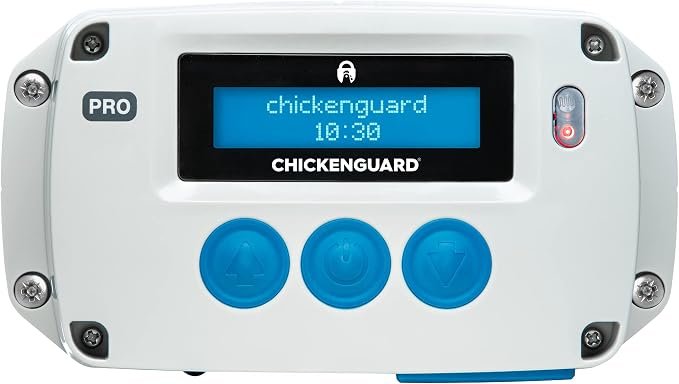
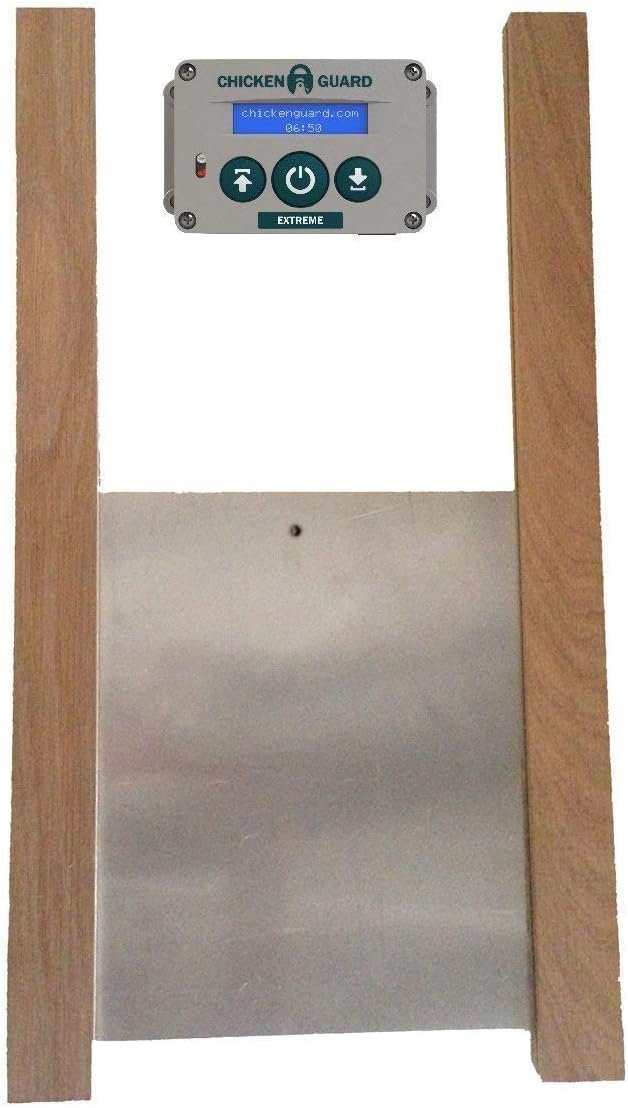
The T50 differs from the ChickenGuard PRO already covered on Outdoor Tech Index because the T50 is a complete door assembly. ChickenGuard PRO is useful when a sound door panel and vertical travel path already exist and only the opener is needed. The ChickenGuard Classic Door Kit Combi is the closer functional alternative because it combines an opener with a door and runners. The T50 wins on compact integration and straightforward battery installation, while the ChickenGuard approach can be preferable for buyers who want separate serviceable components or a specific panel arrangement.
The right decision is not based on the longest feature list. Choose the T50 when its opening fits the flock, the wall supports a flat installation, and two-AA maintenance is acceptable. Choose a motor-only system when the existing door is already proven. Choose a larger or heavier-drive complete door when bird size, snow loading, or the physical opening demands it. In every case, compare manual override, obstruction behavior, installation clearances, warranty, and what is actually included.
Key features
Complete powder-coated aluminum door and drive assembly
Two included AA alkaline batteries
Light-based automatic opening and closing with programmable timing
Current manufacturer page describes RUN-CHICKEN app programming
Manufacturer-listed size of 13.8 by 9.4 by 1.6 inches and weight of 2 pounds
Manual control button and obstruction response described by the manufacturer
Quick Facts
Who It's For
Chicken keepers who want a compact complete automatic door with no wiring or subscription and who can keep the vertical rails clear and inspect the flock daily
Who Should Skip It
Anyone for whom this is a dealbreaker: the opening can be tight for unusually large birds, so measure before ordering
How to get started
Treat the T50 as the moving part of a larger flock-security routine. The wall, opening, threshold, natural-light exposure, battery schedule, bird behavior, manual recovery plan, and daily inspection all determine whether automation is dependable.
1. Measure birds, wall, and clearances
Measure the largest bird and observe the flock using the existing pop opening. Mark the T50 assembly footprint, verify at least 12 inches of unobstructed space above it, and check the wall with a level. Repair bowed boards or create a flat mounting plate before asking screws to pull the door straight.
2. Bench-test the exact version
Install the included batteries and identify whether the purchased unit uses the current app workflow, onboard controls, or both. Complete setup, run repeated open and close cycles, try manual control, and save the instructions offline. This catches a version mismatch before holes are drilled.
3. Mount without distorting the frame
Position the unit vertically, mark fasteners, predrill when the wall material requires it, and tighten evenly. Stop before the screws pull the rails inward. Run the door after each fastening stage so a newly introduced bind is easy to locate rather than discovered at dusk.
4. Commission natural-light behavior
Watch at least several real dawn and dusk cycles with the coop's heat lamps, cameras, and yard lights operating normally. Confirm the chosen delay suits the flock. If birds loiter outside, change the husbandry routine or timing instead of assuming an obstruction feature can solve flock behavior.
5. Create cold-weather and debris checks
Keep bedding below the threshold, wipe rails, inspect the frame after wet weather, and look for ice before relying on the next cycle. Replace batteries conservatively before winter or travel. Do not add grease or a coating unless RUN-CHICKEN approves it for the track and local temperature.
6. Rehearse a failure before leaving
Have another person follow the written manual procedure, replace the batteries, clear an obstruction, and secure the coop if the door cannot operate. Verify every bird is seen daily. A tested fallback is part of installation, not an emergency task to invent over the phone.
Build the system around this product
Flat vertical mounting wall
Keeps the integrated rails parallel so the aluminum panel can move without binding.
Measured bird opening
Confirms the largest bird can pass comfortably before the existing opening is changed.
Truthful natural-light location
Lets the light sensor follow outdoor dawn and dusk without a heat lamp or security light confusing it.
Two-AA replacement schedule
Turns the included consumable power source into planned maintenance instead of a surprise failure.
Manual caretaker procedure
Explains how to operate, inspect, clean, and recover the door when the normal routine fails.
Layered predator enclosure
Keeps roof, mesh, latches, apron, and run security independent of one automated opening.
Before you rely on it
- The assembly is vertical and the rails move freely.
- The largest bird passes without squeezing.
- Artificial lights do not create the wrong schedule.
- Manual control works and instructions are stored at the coop.
- Fresh spare AA batteries are available.
- A person still confirms birds, feed, water, ventilation, and enclosure security daily.
Frequently asked questions
+Does the RUN-CHICKEN T50 require a subscription?
No. The door does not require a paid plan, cloud service, hub, or cellular connection. Its recurring consumable is a pair of AA batteries.
+Is the T50 a complete door or only an opener?
It is sold as a complete aluminum automatic door assembly. That is different from motor-only opener kits that require a separate sliding panel.
+Does every T50 include app control?
Current manufacturer pages describe app programming and Bluetooth-equipped variants, but older retail inventory and reviews may describe button-only setup. Verify the exact listing before buying.
+Can it replace a nightly flock check?
No. It automates a door cycle but cannot confirm that every bird is inside, that the run is secure, or that feed, water, and ventilation are safe.
+What should I check before cold weather?
Clear the rails and threshold, verify the frame is still level, install strong batteries, test several cycles, and keep a manual recovery procedure. Freezing rain and debris can obstruct any exposed moving door.